
Ujjain · Culture & food
Culture & Food of Ujjain: Festivals, Traditions and Local Flavours
Ujjain's festivals, from Maha Shivaratri to the Shravan Sawari, its Malwa crafts and traditions, and local food from poha-jalebi to dal-bafla.
Ujjain's calendar follows its temples. Mahakal's processions through the streets, lamps lit on Harsiddhi's pillars, and pilgrims walking the Panchkroshi circuit all mark the turning of the lunar months. Daily life has a rhythm of its own, too: early-morning poha stalls, evening crowds on the ghats, and the slower pace of a Malwa town that has seen empires come and go.
This guide covers the main festivals and when they fall, the living traditions of the city, and the food Ujjain is known for. Festival dates follow the Hindu lunar calendar and change every year. Check the temple committee or the district administration for the dates of a given year.
Festival calendar
Festivals of Ujjain through the year
Periods follow the Hindu lunar calendar, with the approximate Gregorian months. Exact dates change every year; check the temple committee or the district administration before you travel.
Phalguna, Krishna Chaturdashi (February–March)
Maha Shivaratri
The great night of Shiva is Mahakal's biggest festival. A large fair takes place around the temple, and worship continues through the night as devotees queue for darshan of the Jyotirlinga. Expect very long lines and special temple arrangements in the days around it.
Mondays of Shravan into Bhadrapada (July–September)
Shravan Mahakal Sawari
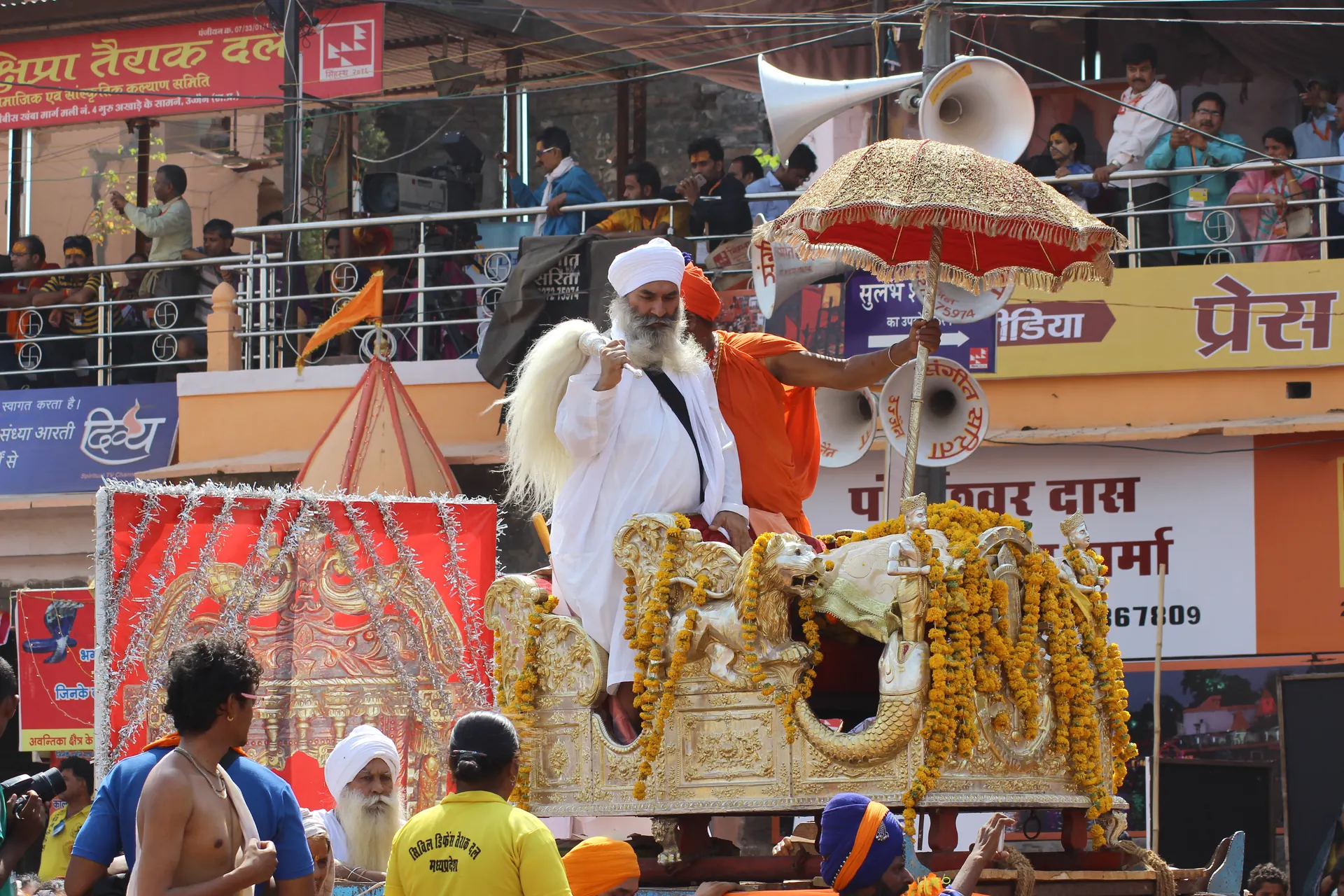
On the Mondays of Shravan, Mahakal leaves the temple in a palanquin procession, the Sawari, and is carried through the old city with bands, flags and singing devotees. The Sawaris continue up to the Bhadrapada Amavasya. The last Sawari, in Bhadrapada, is the grandest and draws lakhs of people. Mahakal's procession also comes out again from Kartika to Margashirsha and on Vijayadashami.
Shravana, Shukla Panchami (July–August)
Nag Panchami
The one day of the year when the shrine of Nagchandreshwar, on the third storey of the Mahakaleshwar temple, opens for darshan. Devotees queue for many hours, and the temple publishes special arrangements for the day.
Chaitra (March–April) and Ashvin (September–October)
Navratri at Harsiddhi and Gadkalika
During both Navratris, Ujjain's goddess temples come alive. At Harsiddhi, the tall lamp pillars in the courtyard are lit and make one of the city's most memorable evening sights. At Gadkalika, thousands of devotees gather for special worship.
Vaikuntha Chaturdashi, Kartika Shukla (October–November)
Harihar Milan
A ritual meeting of Shiva and Vishnu. At midnight, Mahakal's procession travels to Gopal Mandir, where Shiva is said to meet Gopal (Krishna). Tulsi from Gopal ji is later offered to Mahakal. It is a small, atmospheric event with a large local following.
Kartika (October–November)
Kartik Mela
A traditional fair on the banks of the Shipra in the month of Kartika, with bathing, stalls and cultural programmes. Check with the district administration for the dates and venue in a given year.
Annual; dates announced by the Kalidasa Akademi
Kalidas Samaroh
A festival of Sanskrit drama, music, dance and scholarship held in Ujjain every year since 1958 in memory of the poet Kalidasa. The state government established the Kalidasa Akademi in Ujjain to organise it.
Vaishakha (April–May)
Panchkroshi Yatra
A pilgrimage on foot along a sacred circuit around Ujjain, visiting the shrines that guard the city. Thousands of devotees take part every year, many walking through the heat of early summer.
Whenever a new moon (Amavasya) falls on a Saturday
Shanishchari Amavasya at Triveni
Pilgrims gather at the Navagraha temple at Triveni on the Shipra, bathe, and by custom leave behind old clothes and footwear to ward off the influence of Shani (Saturn).
About every 12 years, Chaitra–Vaishakha (around March–May); next due in 2028
Simhastha
Ujjain's Kumbh, held when Jupiter is in Leo. Ascetic orders and pilgrims from across India gather to bathe in the Shipra, with the Shahi Snan at Ram Ghat as the high point. Our Simhastha 2028 guide covers the bathing dates, key ghats and how to plan your visit.
Simhastha 2028 guide
Living heritage
Traditions, art and craft
The everyday culture of a Malwa temple town.
A Malwa city
Ujjain is the heart of Malwa, the plateau country north of the Vindhyas. Hindi is the main language, and Malvi, the region's own language, is still widely spoken in homes, markets and the surrounding villages.
Ujjain is above all a pilgrimage town, and much of its rhythm follows its temples: early mornings around Mahakal, crowded Mondays in Shravan, and quiet afternoons in the lanes of the old city. Its food, from breakfast poha to festive sweets, is pure Malwa.
Ghats, aarti and the Shipra
The Shipra is central to Ujjain's religious life. Ram Ghat, near Harsiddhi, is the oldest and best known of its ghats. Pilgrims come here to bathe, families perform rites for their ancestors, and in the evening an aarti is offered to the river with lamps and bells. Downstream, Siddhavat and Mangalnath have their own riverside rituals, and at Triveni the Navagraha temple draws crowds on auspicious new moons.
Visit the ghats early in the morning or around sunset. Dress modestly, take off your footwear where others do, and ask before you photograph people performing rituals.
Temple art and the Maratha legacy
Much of Ujjain's built heritage dates from the Maratha and Scindia period, when temples were restored and new ones raised. It was also a time when painting styles met in Ujjain. Murals in the Maratha style survive in temples such as Ram Janardan and Kal Bhairav, while the older Malwa style can be seen at Sandipani Ashram.
The same period saw fine wood-carving on the balconies and galleries of old houses. Little of it survives, but a walk through the older neighbourhoods still turns up carved doorways and jharokhas.
Bhairavgarh print
Bhairavgarh, on the Shipra near the Kal Bhairav temple, has been a centre of textile dyeing and printing for centuries. The soil and water are said to suit the colours. The craft began with simple blocks and tie-dye, and moved through carved wooden blocks to chemical dyes and screen printing. Some craft families still make a living from it. Look for Bhairavgarh-printed fabrics, bedcovers and dress material as a souvenir with local roots.
A city of scholars
Ujjain has a long association with poets, astronomers and philosophers, from Kalidasa and Varahamihira to Bhartrihari. That tradition continues in the annual Kalidas Samaroh, in the city's Sanskrit and Vedic learning, and at the Vedh Shala, which still publishes an annual panchang, the Hindu almanac.
Local flavours
What to eat in Ujjain
Malwa food is vegetarian-friendly, generous with sev and ghee, and best eaten fresh. These are dishes, not restaurant recommendations: you will find them across the city.
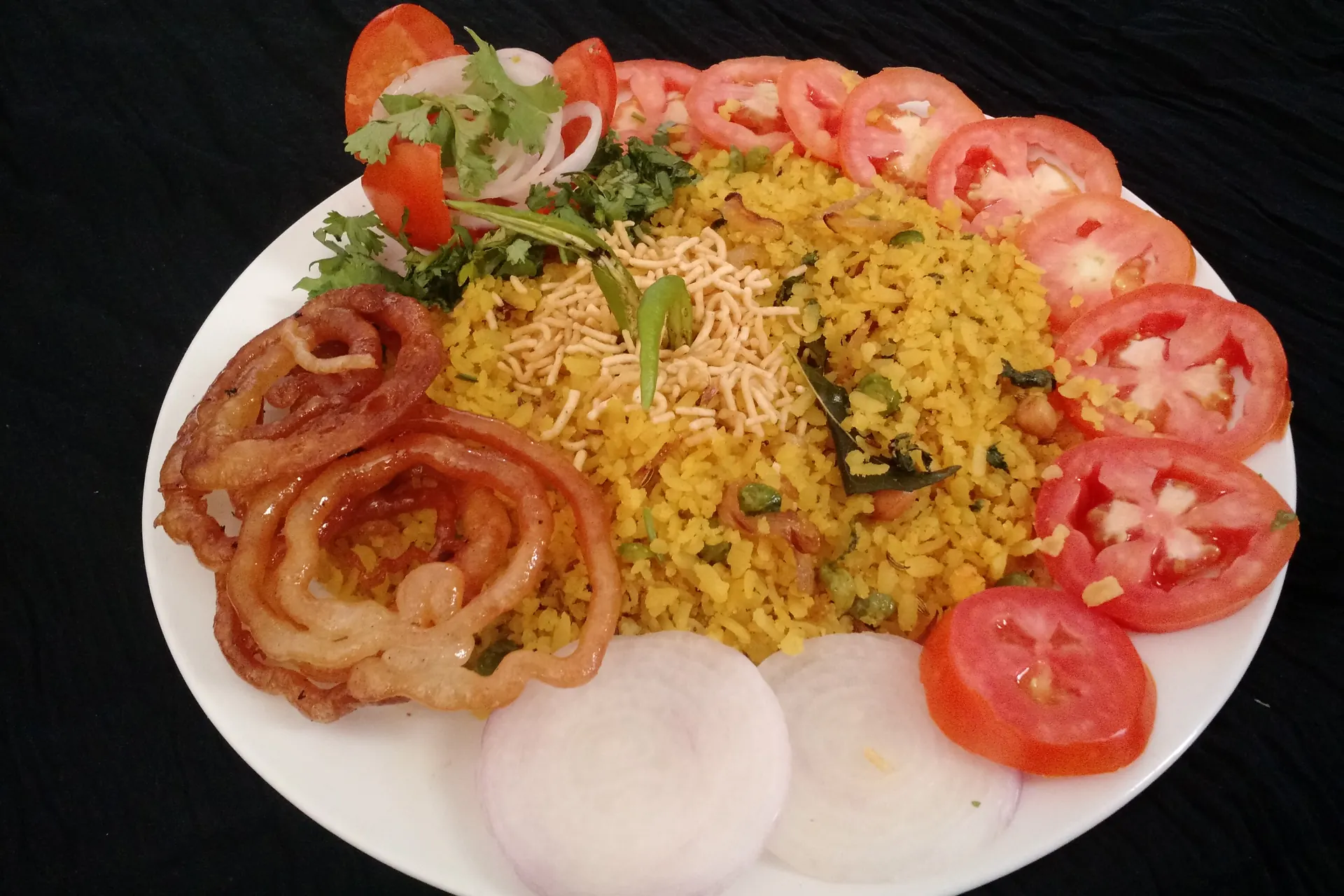
Poha-jalebi
The Malwa breakfast. Flattened rice is lightly spiced with mustard seeds, turmeric and curry leaves, and topped with sev, onion and lemon. It comes with crisp, syrupy jalebi on the side. The sweet and savoury pairing is the point.
When to tryEarly morning, from street stalls and sweet shops
Dal-bafla
Malwa's cousin of dal-baati. Wheat dough balls are boiled first, then baked or roasted until crisp outside and soft inside. They are broken open, soaked in ghee and eaten with spiced dal and chutney.
When to tryLunch, especially at family meals and festive gatherings
Bhutte ka kees
Grated fresh corn cooked in milk and ghee with green chilli, mustard seeds and coriander, until it is soft and gently sweet. It is a Malwa speciality you will rarely find outside the region.
When to tryMonsoon and early winter, when fresh corn is in season
Malpua
Soft, fried sweet pancakes soaked in sugar syrup and often served with rabri. They are a festival favourite and appear in many temple-town sweet shops.
When to tryFestivals, especially around Holi and in the cooler months
Sabudana khichdi
Tapioca pearls cooked with peanuts, potato, green chilli and cumin. It is light, satisfying and the standard food for fasting days.
When to tryFasting days such as Maha Shivaratri, Navratri and Shravan Mondays
Kachori
Flaky, deep-fried pastry filled with spiced lentils or peas, served hot with tangy chutney. It is popular as a breakfast or mid-morning snack.
When to tryMorning and early afternoon
Sev
Crisp gram-flour noodles seasoned with spices. Malwa is known for sev, and it is scattered over almost everything, from poha to chaat, or eaten by the handful.
When to tryAny time; it also travels well as a gift
Aalu bada
Spiced potato dumplings fried in a gram-flour batter and served with green chutney. It is a favourite street snack, often eaten in a bun or on its own.
When to tryEvening snack time
Gulab jamun and rabri
Fried milk-solid dumplings soaked in rose-scented syrup, and rabri, milk slowly thickened into sweet, creamy layers. Rabri is often eaten with jalebi.
When to tryAfter a meal or as an evening treat
Shopping
Markets and shopping areas
Neighbourhoods worth a wander for everyday shopping, devotional items and local textiles.
Freeganj and Tower Chowk
A well-to-do neighbourhood close to Ujjain Junction, centred on the Ghantaghar clock tower. Its streets have shops, eateries, coaching institutes and many of the city's hotels, which makes it a convenient base for everyday shopping.
Old city around Gopal Mandir
Gopal Mandir stands at the centre of the old city, and the lanes around it form a traditional market area. Expect busy, narrow streets of small shops, best explored on foot.
Around Mahakal and Patni Bazaar
The streets leading to the Mahakaleshwar temple, including the way past the Chaubis Khamba temple towards Patni Bazaar, are lined with shops selling flowers, prasad, rudraksha, idols and other devotional items.
Bhairavgarh
The neighbourhood by the Kal Bhairav temple is known for its traditional printed textiles. It is the place to look for Bhairavgarh print.
References
Further reading
Official pages and reference articles we drew on for this guide. Official pages are updated from time to time, so they are the best place for the latest details.
- Ujjain district administration – Culture & Heritage (opens in a new tab)
- Ujjain district administration – Festivals (opens in a new tab)
- Ujjain district administration – Culinary Delights (opens in a new tab)
- Ujjain district administration – Handicraft (opens in a new tab)
- Ujjain district administration – Places of Interest (opens in a new tab)
- Ujjain district administration – History (opens in a new tab)
- Wikipedia – Ujjain (opens in a new tab)
- Wikipedia – Freeganj (opens in a new tab)
Good to know
Culture & food: frequently asked questions
What is the best festival to see in Ujjain?
For spectacle, see a Monday Mahakal Sawari in Shravan, or Maha Shivaratri at the temple. For a quieter experience, try Navratri evenings at Harsiddhi or the midnight Harihar Milan at Gopal Mandir. Every twelve years, the Simhastha eclipses them all.
When does the Mahakal Sawari take place?
The Sawari goes out on the Mondays of Shravan and continues up to the Bhadrapada Amavasya, roughly July to September. The exact dates change each year with the lunar calendar.
What food is Ujjain famous for?
Poha with jalebi for breakfast, dal-bafla for a hearty meal, and Malwa specialities such as bhutte ka kees and sev. On fasting days, sabudana khichdi is everywhere.
Is food near the temples vegetarian?
Ujjain's traditional dishes, such as poha, dal-bafla, kachori and sabudana khichdi, are vegetarian, and vegetarian food is easy to find around the temples. If you have specific dietary needs, ask at the place itself.
What can I buy in Ujjain as a souvenir?
Bhairavgarh-printed textiles, Malwa sev and namkeen, and devotional items such as rudraksha and small idols from the shops around Mahakal.
What language is spoken in Ujjain?
Hindi is the main language, and Malvi, the regional language of Malwa, is also widely spoken.
Related guides
Continue exploring Ujjain
- Eat wellUjjain food guideWhere and when to eat on a temple-town itinerary.
- Visitor guidesPlaces to visit in UjjainThe temples and ghats behind the city's festival calendar.
- HeritageHistory of UjjainFrom Avantika and the Mauryas to the Maratha city of today.
- Ujjain's KumbhSimhastha 2028The twelve-yearly gathering on the Shipra.